
Your CFO calls with an urgent request. The voice is right. The accent is right. Even the little pauses sound familiar. But your CFO never made that call.
This is deepfake fraud. Criminals use AI to clone real voices and faces. Then they use those clones to ask for money, data, or access. The tools are cheap, fast, and easy to find. And they keep getting better.
This blog explains how deepfake fraud works and why it succeeds. You will see a real loss and a real save. You will also learn why spotting fakes by eye no longer works. Then you get a plan to stop attacks before money moves.
Key Takeaways
- Deepfake fraud uses cloned voices and faces to trigger payments.
- Many attacks start with a normal message, then escalate to a call.
- People cannot reliably spot deepfakes, even when warned.
- Urgency and secrecy are the biggest red flags in any request.
- A callback to a known number beats any detection trick.
- Fake job candidates are the next big deepfake threat.
- Process controls, not gut feelings, stop deepfake fraud.
What Is Deepfake Fraud?
| Type | How it works | Typical target |
|---|---|---|
| Voice clone call | A cloned executive voice calls with an urgent request. | Finance and treasury staff |
| Deepfake video call | Fake faces join a live meeting to approve a transfer. | Employees who handle payments |
| Voice note or chat message | A cloned voice arrives through a messaging app. | Executives and their assistants |
| Fake job candidate | A synthetic face sits for a remote interview. | Recruiters and hiring managers |
| Help desk impersonation | A cloned voice asks IT to reset access. | IT and support teams |
How a Deepfake Attack Unfolds
Most deepfake scams follow the same playbook. Here is how a typical attack moves from public footage to a wire transfer:
- Research the target. Attackers study org charts, LinkedIn profiles, and press releases. They learn who approves payments and who that person trusts.
- Harvest voice and video. Earnings calls, podcasts, webinars, and social clips supply the raw material. Public executives give attackers plenty to work with.
- Build the clone. AI tools turn those clips into a convincing voice or face. Some tools now work in real time during a live call.
- Set the stage. A message arrives first, often an email or a chat from a new number. It mentions a secret deal and asks for discretion.
- Close with the clone. A call or video meeting follows to remove any doubt. The fake executive pushes for a fast payment before anyone checks.
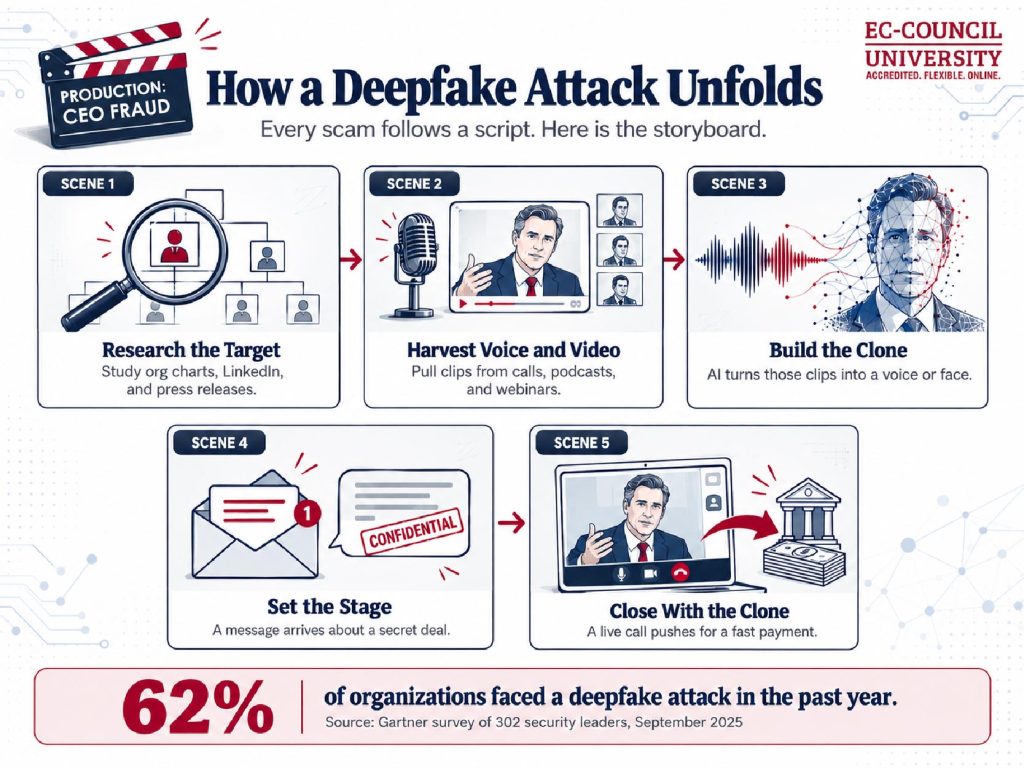
Notice the pattern. Every stage targets trust and speed. Very few stages target technology at all.
How Big the Deepfake Fraud Problem Has Become
Deepfake attacks are no longer rare. Gartner surveyed 302 security leaders in 2025. 62% said their organization faced a deepfake attack in the past year.
The FBI now tracks the damage too. Its 2025 Internet Crime Report added its first AI section. That section logged 22,364 complaints and $893 million in losses.
Those AI numbers tell only part of the story. Deepfakes often power business email compromise. BEC alone cost victims $3.046 billion in 2025. That works out to roughly $123,000 per incident.
Arup vs. Ferrari: One Loss, One Save
Two well-known cases show how thin the line is between loss and safety.
Arup: The Video Call That Cost Millions
In early 2024, an Arup finance employee in Hong Kong received an email. It claimed to come from the company’s UK-based CFO. It asked for a secret transaction. At first, the employee had doubts.
Then came a video call. The CFO appeared, along with several familiar colleagues. Every one of them was a deepfake. Convinced, the employee made 15 transfers to several bank accounts. The total came to about $25 million. The fraud surfaced only after the employee checked with headquarters.
Ferrari: The Question That Stopped a Clone
In July 2024, a Ferrari executive received WhatsApp messages from “CEO Benedetto Vigna.” They came from an unfamiliar number and mentioned a confidential deal. A phone call followed, with a near-perfect copy of Vigna’s accent.
Something still felt off. So the executive asked which book Vigna had recently recommended. The caller could not answer and hung up. No money moved.
| Arup | Ferrari | |
|---|---|---|
| Channel | Email, then a video call | Chat messages, then a voice call |
| Red flags | Secrecy and urgency | Unknown number, secrecy, unusual deal |
| What decided it | Visual trust overrode early doubt | A personal question tested identity |
| Outcome | About $25 million lost | No money moved |
Why Your Eyes and Ears Are No Longer Enough
Many teams still train staff to spot glitches. Watch for odd blinking, they say. Listen for a robotic tone. That advice is aging fast.
iProov tested 2,000 UK and US consumers on real and fake content. Only 0.1% identified every item correctly. And those people knew they were looking for fakes.
Video proved even harder. Participants were 36% less likely to catch a fake video than image. Yet 60% still felt confident in their detection skills.
So stop asking staff to be human lie detectors. Build processes that work even when the fake is perfect.
The Next Target: Your Hiring Process
Deepfakes are not only after your money. They are also after your payroll and your network.
Remote hiring makes this easier than ever. A fraudster can wear a synthetic face during a video interview. Once hired, they gain real credentials and real system access.
The trend is growing fast. Gartner predicts one in four candidate profiles could be fake by 2028. Security and HR teams now need to work together. Identity checks belong in hiring, not just in IT.
How to Stop Deepfake Fraud: A Step-by-Step Plan
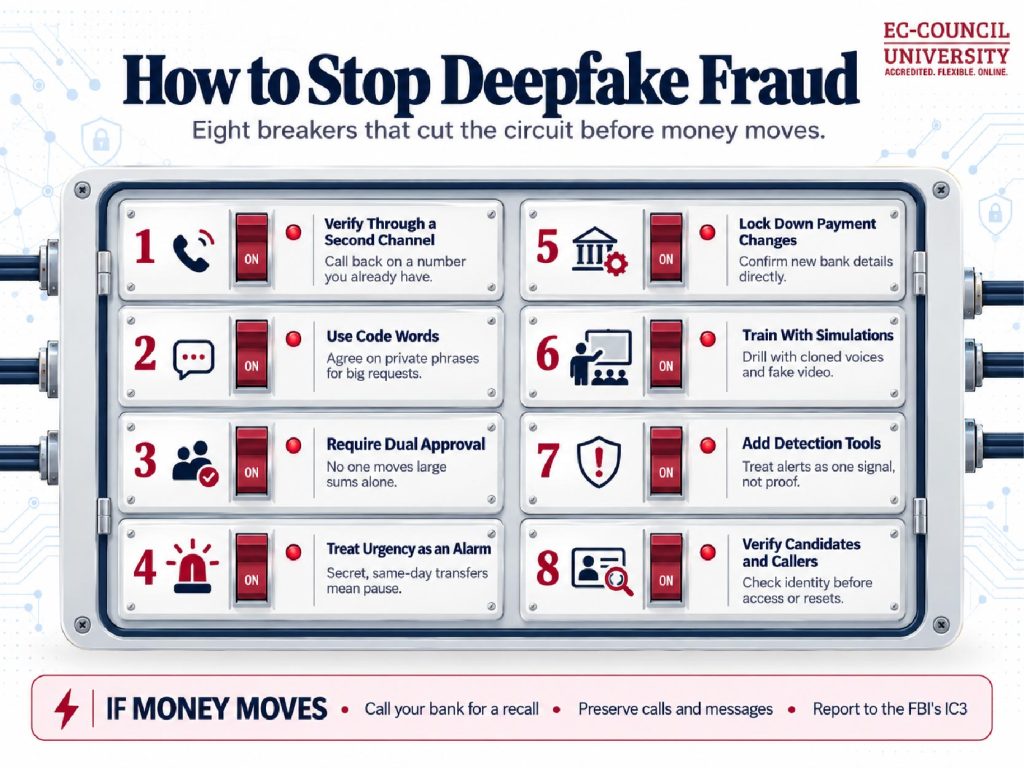
You cannot out-spot a perfect fake. But you can out-process it. These steps make a cloned voice useless:
- Verify through a second channel. Never act on a call, video, or message alone. Hang up and call back on a number you already have.
- Use challenge questions or code words. Agree on private phrases for high-value requests. Ferrari’s book question shows how well this works.
- Require dual approval for payments. No single person should move large sums alone. A second approver breaks the attacker’s momentum.
- Treat urgency and secrecy as alarms. Real executives rarely demand secret, same-day transfers. Make it safe for staff to pause and check.
- Lock down payment changes. Confirm any new bank details with the vendor directly. Never accept account changes by email or call alone.
- Train with realistic simulations. Run drills using cloned voices and fake video requests. Pair them with your wider employee security training program.
- Add detection to your meeting tools. Detection software can flag synthetic audio and video. Treat its alerts as one signal, not a final verdict.
- Verify candidates and help desk callers. Add live identity checks to remote hiring. Make IT confirm identity before any password or MFA reset.
Plan for a bad day, too. If money moves, call your bank immediately to try a recall. Preserve call logs, recordings, and messages for investigators. Then report the incident to the FBI’s IC3.
Skills That Fight Deepfake Fraud
Stopping deepfakes takes more than one skill set. Responders must act fast when a fake gets through. Investigators must trace what happened and preserve evidence. And leaders must build approval rules that hold under pressure.
ECCU offers three paths that map to this work.
- MSCS Incident Management and Cyber Operations: This track covers incident handling, disaster recovery, and organizational change. You learn to contain an attack fast and restore operations. It prepares you for the EC-Council Incident Handler (ECIH) exam.
- MSCS Digital Forensics: You learn to investigate intrusions, analyze mobile devices, and apply cyber law. Those skills help trace deepfake fraud and support recovery efforts. The track maps to the CHFI certification.
- MBA in Cybersecurity Executive Leadership and Governance: This specialization fits leaders who own payment and approval policy. A course on profiling the IT criminal helps you understand how attackers think. AI governance coursework adds a framework for managing AI-era risk.
Deepfakes will keep getting more convincing. Strong processes and trained people will keep them from working. Not sure which path fits you? Talk to an ECCU enrollment advisor and map your next step.
Frequently Asked Questions
What is deepfake fraud?
How do scammers clone someone's voice?
They feed public recordings into AI voice tools. Earnings calls, podcasts, and social videos all work. The tool then speaks any script in that person’s voice.
Can deepfake detection software stop these attacks?
Can deepfake detection software stop these attacks?
It helps, but it is not enough alone. Detection tools can miss new techniques. Pair them with callback rules and dual approvals.
What are the warning signs of a deepfake call?
Watch for urgency, secrecy, and unusual payment requests. Be wary of new numbers or new messaging accounts. Any pressure to skip normal checks is a red flag.
What should I do if I suspect a deepfake?
Stop, and do not send money or data. End the call and verify through a known channel. Then report it to your security team right away.
How can companies protect hiring from deepfake candidates?
Add live identity verification to remote interviews. Match identity documents to the person on camera. Keep checking identity during onboarding and first logins.